Originally published on Medium · August 5, 2021
The Congress will soon vote on a massive and broadly supported bipartisan infrastructure bill spanning 2,700 pages. Tucked away in this bill is a short provision relating to so-called "brokers" in digital assets. Brokers are subject to significant self-reporting and KYC requirements under the Internal Revenue Code, among other statutory and regulatory obligations.
The bill in its current form threatens to add Bitcoin miners to the definition of "broker" — and foist upon them the severe regulatory burdens associated with that designation — because it will now include "any person who (for consideration) is responsible for regularly providing any service for effectuating transfers of digital assets on behalf of another person." Bitcoin observers and others from across the cryptocurrency spectrum quickly realized that this could include just about anyone interacting with the crypto space.
In short: it is a broad scale license to surveil.
Following significant pushback from the industry, United States Senators Lummis, Wyden and Toomey introduced an amendment hoping to rectify the situation. And in large part, it goes a long way to doing that. But on closer examination, the language may fall short of protecting Bitcoin miners and other PoW-based chains.
Below is a snapshot of the relevant text of the amendment.
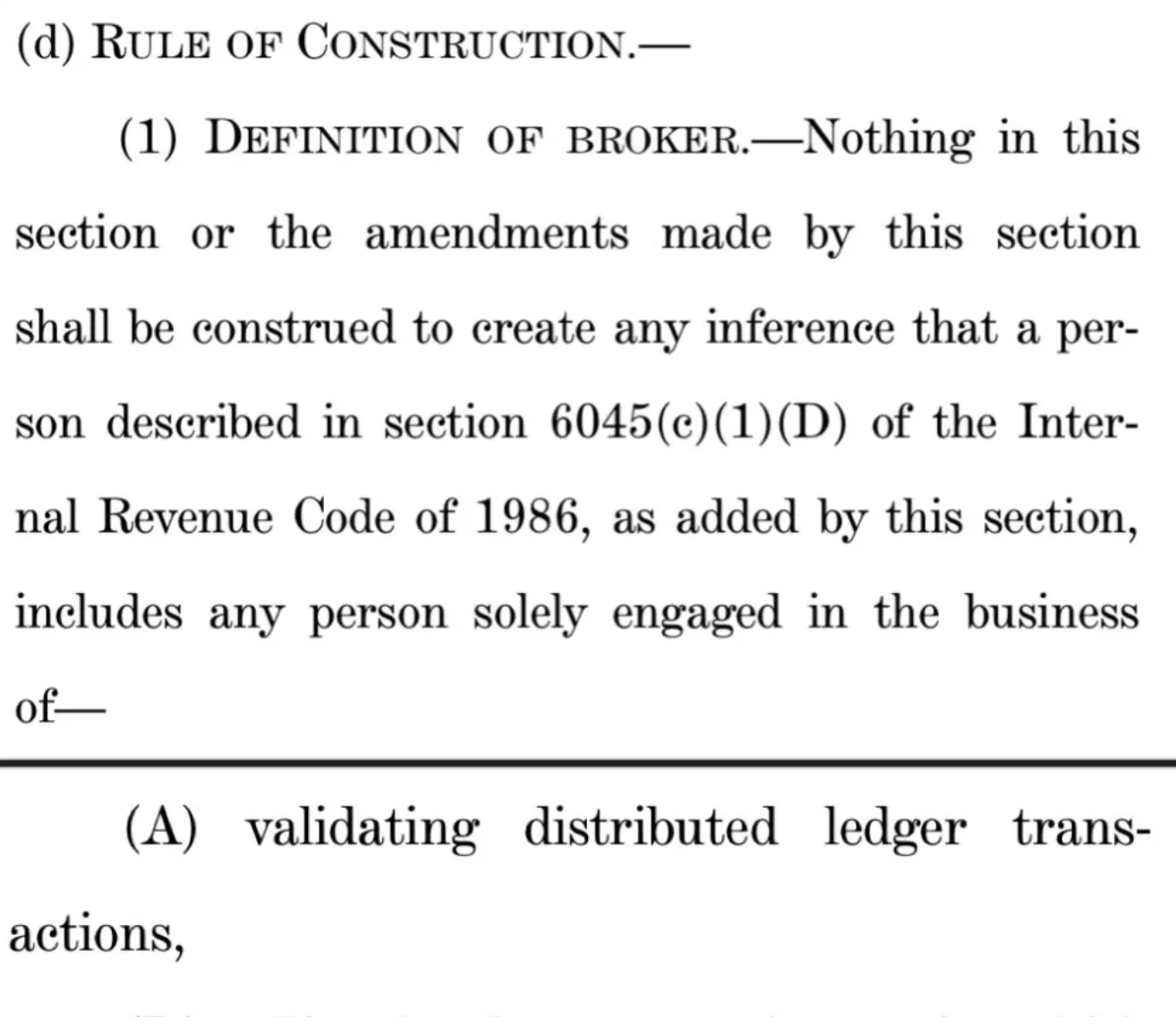
As you can see, it really limits the protection to those who are "validating distributed ledger transactions." Ostensibly, this is meant to protect bitcoin miners who are often characterized as transaction validators because they "update the chain." But is that really what they do?
Looking at the bitcoin protocol and how it actually updates reveals a wrinkle in the amendment language that could inadvertently remove bitcoin miners from the protections of the amendment. Here's why.
When miners add a block of transactions to the bitcoin blockchain, they bundle recent transactions and then attach a cryptographic nonce (or puzzle solution) demonstrating they engaged in the required amount of computational work. At best, this might be considered sufficient to begin the process of validating transactions, but it does not "validate" transactions any more than any individual full node on the network does.
Instead, transactions are validated by the collective acts of the majority of nodes on the bitcoin network, with each accomplishing their own validation of transactions and each independently accepting the miner's proposed block. This process is what truly "updates" the chain in a technical sense. And this is why Full Nodes download the entire blockchain in the first place. In other words, a miner can neither update nor validate the chain by itself. It requires the agreement and independent verification of the broader full node community to go forward.
These are critical gaps between the operation of the legal language contained the Lummis amendment, and the reality of how the bitcoin protocol functions. And it may completely remove bitcoin miners from the protection of the amendment.
The good news is these gaps can be quickly and simply fixed by adding the following language to the amendment:
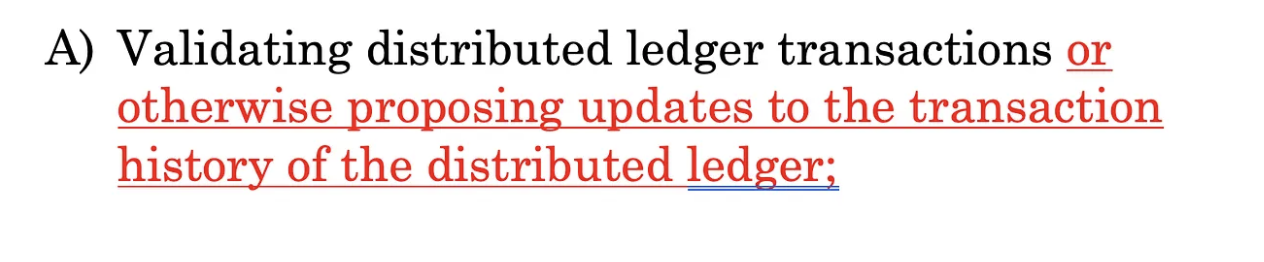
Beyond this small but necessary change, it would be wise to adjust the definition of broker with the proposed language below so as to ensure it exempts from the definition those who operate multiple business lines beyond just mining (i.e. Mining and Wallet providers).
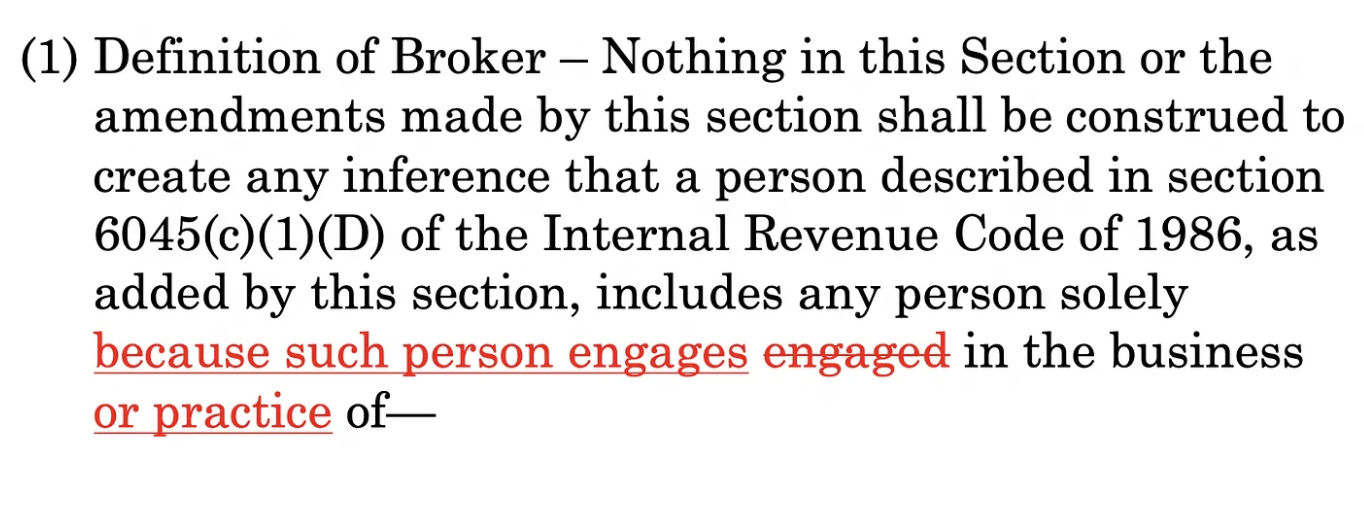
These changes are simple and relatively neat. They do not disturb the substance of the bill except to ensure the amendment accomplishes its intended purpose.